




























Views
Downloads


Area of Parallelograms (Decimals) | Grade 5 Essential

Paste this activity's link or code into your existing LMS (Google Classroom, Canvas, Teams, Schoology, Moodle, etc.).
Students can open and work on the activity right away, with no student login required.
You'll still be able to track student progress and results from your teacher account.
This worksheet helps students master finding the area of parallelograms using decimal dimensions. Students apply the formula to solve calculation tasks, find missing dimensions, and navigate word problems. It provides a structured approach to geometric measurement, ensuring learners accurately multiply decimals while understanding the relationship between base and height.
At a Glance
- Grade: 5 · Subject: Math
- Standard:
CCSS.MATH.CONTENT.6.G.A.1— Find the area of special quadrilaterals by calculating base times perpendicular height- Skill Focus: Area of Parallelograms with Decimals
- Format: 3 pages · 14 problems · Answer key included · PDF
- Best For: Independent practice and geometric measurement mastery
- Time: 25–35 minutes
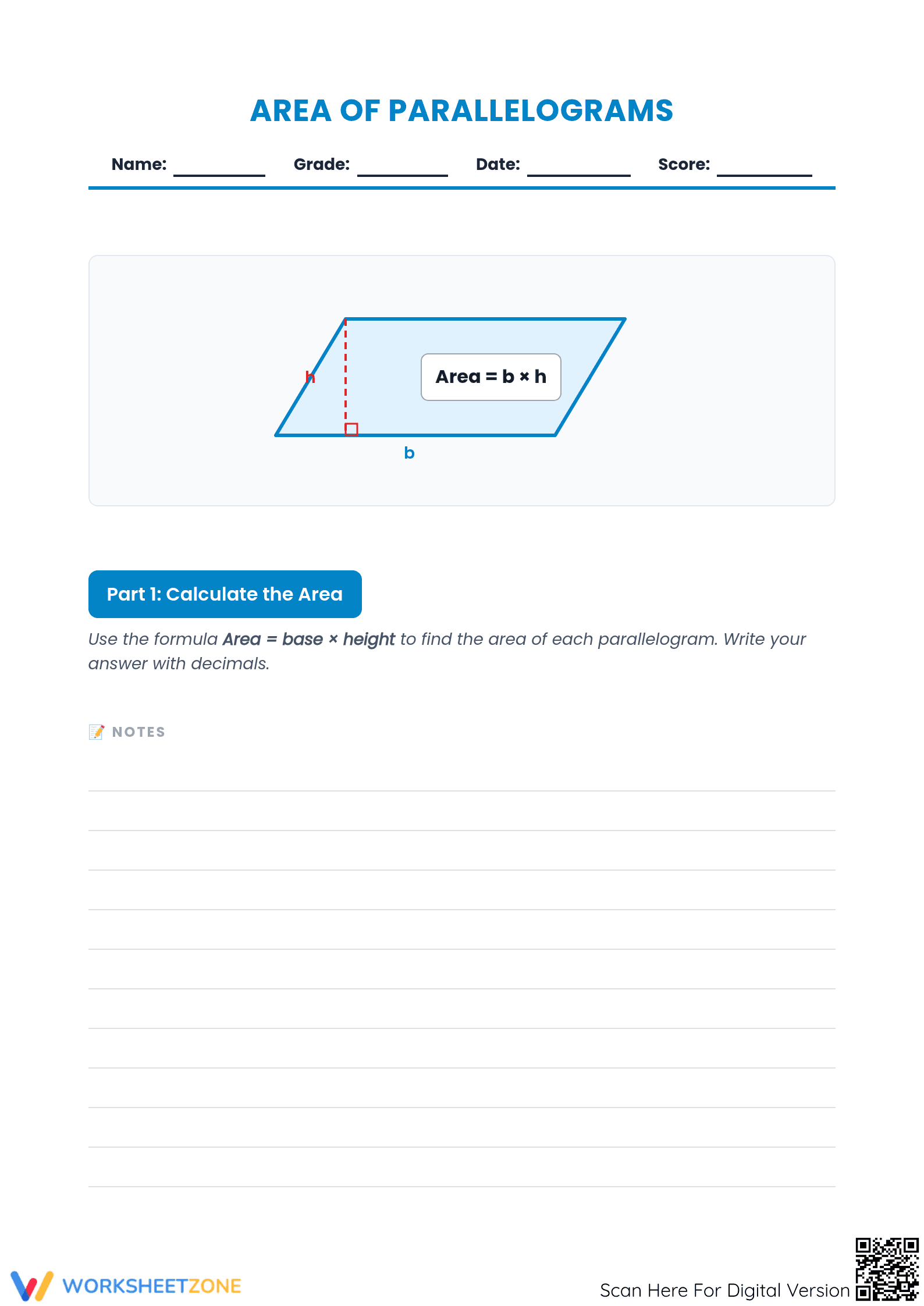
This 3-page PDF includes 14 high-quality math problems divided into three distinct sections. Page one provides a clear visual diagram and the essential formula for reference, along with a notes section for students. Page two features 8 calculation problems and 4 "missing dimension" challenges. Page three presents 2 comprehensive word problems. A full answer key is provided to facilitate quick grading and self-correction.
Skill Progression
- Guided practice starts with 8 direct calculation problems where students multiply the given base and decimal height to find the total area using standard units.
- Supported practice involves 4 problems that reverse the formula, requiring students to find a missing base or height when the area is known.
- Independent practice concludes with 2 word problems that ask students to apply their knowledge to practical scenarios like garden layouts and decorative tile designs.
This gradual-release model moves students from simple procedural fluency to higher-order applications using the I Do, We Do, You Do method.
Standards Alignment
CCSS.MATH.CONTENT.6.G.A.1 states: "Find the area of right triangles, other triangles, special quadrilaterals, and polygons; apply these techniques in the context of solving real-world and mathematical problems." This resource supports this goal by focusing on parallelograms. Standard codes can be copied directly into lesson plans or curriculum mapping tools.
How to Use It
Use this worksheet during a geometry unit after students have learned the area formula for rectangles. It serves as an excellent bridge to more complex polygons. For a formative assessment observation, watch how students handle the decimal multiplication and ensure they correctly identify the perpendicular height rather than the slant height. Expect completion in roughly 30 minutes.
Who It's For
This resource is designed for Grade 5 and 6 students who have a solid grasp of decimal multiplication. It is particularly useful for small-group instruction, math centers, or as a homework assignment. It pairs naturally with a geometric passage about real-world shapes or a direct instruction lesson on measurement units.
According to the RAND AIRS 2024 report on math education, structured practice with formulas is essential for spatial reasoning. This Grade 5 worksheet focuses on CCSS.MATH.CONTENT.6.G.A.1, providing 14 problems that find the area of parallelograms using decimal measurements. By integrating calculation tasks with word problems, the resource ensures students understand the relationship between a shape's base and height. This approach aligns with evidence-based strategies that favor a progression from calculation to application. Educators can use this printable tool to assess student mastery in geometric measurement and decimal operations, making it a valuable addition to any upper-elementary math curriculum.


